The Responsibility to Protect (R2P) and the ethics of responsibility

On May 29, King & Wood Mallesons, the International Law Association (Victoria Chapter) and the Australian Red Cross organized an event on “The Responsibility to Protect: Where to from here?” featuring presentations from leading R2P experts Gareth Evans, Damien Kingsbury and Phoebe Wynn-Pope.

Even if it is often seen as synonymous with humanitarian intervention, R2P has its origins as a principle of international law in the Report  of the International on Intervention and State Sovereignty (ICSS) of 2001. As Damien Kingsbury noted, even if a moral principle informs the two concepts, humanitarian intervention and R2P have different scopes. In a nutshell, the R2P principle aims at the protection of the most vulnerable populations from the most heinous international crimes: genocide, crimes against humanity, war crimes, and ethnic cleansing. To Professor Evans, the principle has the virtue to have introduced the language of protection in the dominant discourse of state sovereignty, usually characterized by its “conspicuous indifference” towards state misbehavior vis-à-vis its own people. He also offered a brilliant walkthrough on the life stages of R2P by distinguishing three phases: (i) birth and early childhood (2001-2005): from its inception in the 2001 Report to its endorsement by heads of state and government at the 2005 UN World Summit; (ii) early lessons learned (2005-2010) in facing the growing conceptual, institutional, and political challenges that the practical implementation of the project would pose (see the UN Secretary’s report on Implementing R2P); (iii) maturity (2011-) with crystallizes in the explicit invocation of the principle in the Libya crisis (which Evans define as a “textbook case”) but also in the renewed concerns and caution out of the implementation of Resolution 1973 in Libya (whether NATO has gone beyond the UN mandate to protect the Libyan people) that help to explain the current paralysis over Syria.  According to Professor Evans, the present situation calls for the “need to regain consensus” on the implementation on the principle. In this perspective he situates the current debate on the related concept of “Responsibility While Protecting” (RwP) as recently brought by Brazil’s Permanent Mission to the UN.

On a different note, Phoebe Wynn-Pope referred to the role of non-state actors and civil society in working with national, regional and international actors to respond to the threat of genocide, war crimes, crimes against humanity and ethnic cleansing. In this line, the Australia Red Cross handbook that she presented at the event states that “While these non-state actors are unlikely to have a ‘legal’ responsibility under international law, there is strong argument that a ‘moral’ responsibility exists”. In a similar vein, and expressing its disappointment with the exclusion of the civil society role on the RwP debate, the ICRtoP highlights that:

Civil society is crucial in monitoring the implementation of RtoP by actors at the national, regional, and international levels. NGOs also work to galvanize the political will to prevent and halt the four crimes through improving understanding of RtoP and alerting actors to at-risk situations.

There are many examples in the emergent domain of crisis mapping showing how individuals, networks, and civil society organizations are already playing a significant role (see my previous post). But the uneasiness to accommodate the role of the civil society and other non-state actors within the paradigm of R2P goes far beyond of the debate on how this role can be effectively coordinated with the mandate of the States. Moral and legal responsibilities operate at different levels, and the former tend to creak under the structures of Westphalian states, their interests, and their international relations. R2P may certainly have infused a new language to the institutionalized indifference of Westphalian states. Yet, and despite having stroke a rare chord, the harmony remains Westphalian. It seems to me that perhaps it would be better to distinguish between the “narrow but deep” R2P principle that applies to the individual and collective action of the states under international law, and the ethics of responsibility that all citizens and civil society groups bear as they engage in preventing, denouncing, or documenting human rights violations.  Please note that I’m referring here to an ethics of responsibility in the Emmanuel Levinas sense of responsibility for the Other: “I am responsible for the Other without waiting for reciprocity, were I to die for it. Reciprocity is his affair. It is precisely insofar as the relation between the Other and me is not reciprocal that I am subjection to the Other; and I am ’subject’ essentially in this sense” (E. Levinas. 1982 Ethics and Infinity – Conversations with Philippe Nemo. Pittsburgh (Pa): Duquesne University Press (1985 English Edition).

Emmanuel Levinas

In this perspective, it is difficult to imagine how states could be understood as “subjects” in the Levinasian sense. Even if this is a radical assumption, I think it remains useful to clarify the different dimensions of responsibilities and duties that states, organizations, and individuals bear.

Marta Poblet

Posted in Human rights, Law, Uncategorized | Tagged , , , , | Leave a comment

Crowdsourced crisis mapping: how it works and why it matters

Marta Poblet and Pompeu Casanovas

Web 2.0 tools and mobile technologies have lowered the barriers not just for people to access the internet but to create and share content. Through open-source, collaborative programs such as wikis, the creation and distribution of information has effectively been crowdsourced.

But can this democratisation of the production of information and the expansion of networked global communities lead to action in solving real-world problems?
As inventor Vinay Gupta of Hexayurt sharply puts it: “Ten years from now there will be 2 billion people with broadband internet access, but no toilet.”

Access to technology is only ever one side of the problem. The other is how people bridge the gap between the creation and sharing of knowledge and action based on that information. Crowdsourced crisis mapping represents a significant step upon this path.

Read the full article at The Conversation.

Posted in crisis mapping, crowdsourcing, political crowdsourcing | Tagged , | 1 Comment

Endeavour, Venus, and citizen science

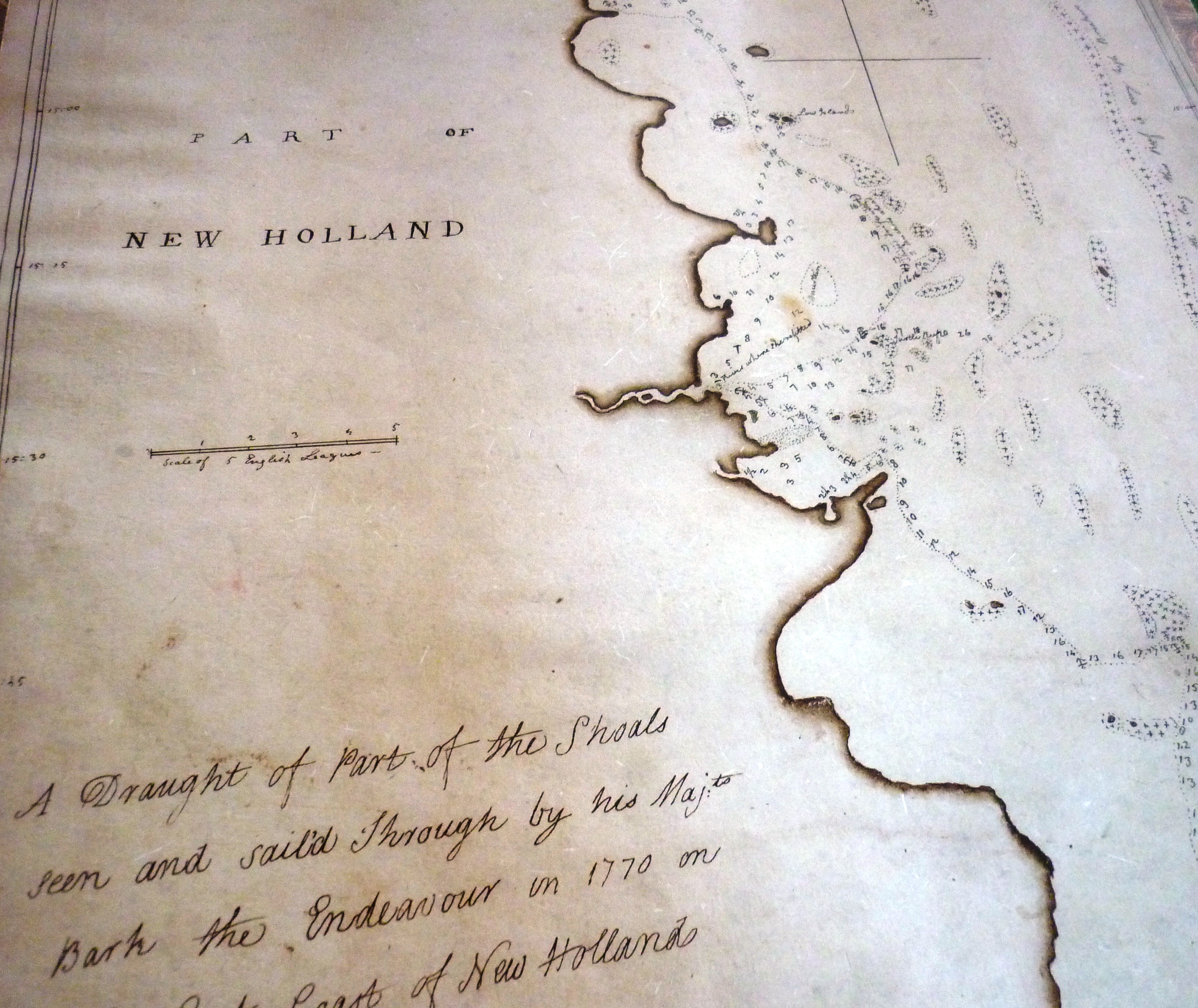
This week, the magnificent Australian-built replica HMB Endeavour could be visited at the Waterfront City Marina in Melbourne. On 26 August 1768, the real HMB Endeavour, commanded by Lieutenant James Cook, sailed from Plymouth to the South Pacific Ocean. The aim of the expedition was twofold: to observe the 1769 transit of Venus across the disc of the Sun and, as contained in the Secret Instructions given to Cook, to explore, map, and eventually take possession of the hypothesized Terra Australis Incognita.

Cook's chart of New Holland East coast (1770)

By observing the passage of Venus across the Sun astronomers had long expected to resolve what Wayne Orchiston has defined as “the most pressing problem in world astronomy” at that time, which was to determine the length of the astronomical unit, or the mean distance from Earth to the Sun.  As Donald A. Teets referred in his 2003 paper:

Though the idea of using a transit of Venus or Mercury to determine the solar parallax dates back at least to the Scottish mathematician James Gregory in 1663, it was Edmond Halley who became its greatest advocate. Halley observed a transit of Mercury from the southern hemisphere in 1677, and in his report on the observations, he discussed the possibility of using transits of Mercury or Venus to determine the solar parallax. Of the two, he believed that the geometry of Venus transits was far more likely to produce accurate results. Halley proposed the Venus transit idea in papers presented to the Royal Society in 1691, 1694, and most importantly, in 1716.  (…).

Halley’s paper called for observers to be stationed far and wide across the globe, a monumental task in 1761. Despite the obvious difficulties involved in sending observers on distant locations, not to mention the fact that Great Britain and France were in the midst of the Seven Years’ War at the time, the response of his call was overwhelming. In all, when the transit took place, there were at least 122 observers at sixty-two separate stations, from Calcutta on the Siberian city of Tobolsk, from the Cape of Good Hope to St.John’s in Newfoundland, and of course, at a large number of locations throughout Europe. Many had traveled weeks or even months to reach their destinations. (Donald A. Teets. 2003. Transits of Venus and the Astronomical Unit. Mathematics Magazine, Vol. 76, No. 5: 335-348).

Both Halley’s call for global observers to the two scheduled transits of Venus in 1761 and 1769 and the response it received are astounding examples of scientific crowdsourcing.  The data gathered after the two observations drew the length of the astronomical unit “ever closer to the values accepted today” (Teets 2003: 347) so that 19th century astronomers using these data “. . . knew the distance to the Sun much better than present-day astronomers know the distance to the centre of the galaxy.” (Wolley 1970: 135; quoted in Orchiston (2004: 62)).

Drawings of the Transit of Venus by Captain James Cook and Charles Green

What is new to present-day scientific endeavours, nevertheless, is that astronomers of the 21st century can benefit from the unprecedented global effort of hundreds of thousands of volunteers who are able to deal with ever-growing datasets. In this line, the Citizen Science Alliance hosts one of the most popular collections of projects where citizens can contribute to classify galaxies (galaxyzoo.org), help to measure our Milky Way (milkywayproject.org), explore the Moon using high-resolution NASA imagery (moonzoo.org), discover new planets around other stars (planethunters.org), and spot explosions on the Sun (solarstormwatch.org), among many others. Citizen science leverages the fact that humans excel in their pattern recognition abilities, being more reliable than machines in most cases, especially when a decision is to be made in a grey area. But, all in all, citizen science relies on the passion and cooperative behavior that is inherent to great discoveries.

As a reminder, the next transit of Venus across the Sun is scheduled on June 6, 2012. Mark your calendars and enjoy it!

Marta

Posted in citizens science, crowdsourcing | Tagged , , | Leave a comment

Tagging Constitutions Online: Constitution Day in Barcelona

On Saturday morning, November 12, a group of 70 law students convened in one of the rooms of the UAB Law School to participate in Constitution Day, an international event organized by the Program on Liberation Technology at Stanford’s Center on Democracy, Development, and the Rule of Law. The other two events were held at Stanford University and the University of Edinburgh. The aim of Constitution Day was to tag national constitutions with a predefined set of categories in order to feed the Constitution Explorer, a structured online database that will enable people to compare and contrast other countries’ constitutions.

Spanish Constitution, by Landahlauts

Students were given a crash course to get familiarized with the task—the annotation of the constitutional articles with a set of tags—and the taxonomy of concepts for annotation. As a result, each article of a constitution was categorized by subject, so that the Constitution Explorer user will be able to browse constitutional texts by concept and, whenever possible, will also find notes that will clarify each article and the issues that it relates to.

The taxonomy contains roughly 300 terms and was manually elaborated by a group of Stanford researchers and subsequently refined in collaboration with other researchers in the US, Barcelona, Edinburgh, and Morocco. According to Meritxell Fernandez Barrera, researcher at the Institute of Law and Technology and coordinator of the annotation event at the UAB Law School, students enjoyed to engage in collaborative discussions and had fun with the experience, even if they had to struggle at some point with some of the tagging concepts: “some tags wouldn’t really work, for example, those referring to the territorial organization of the state: the taxonomy had ‘federal state’ as a concept, but they didn’t feel at ease with the term—Spain is hardly a federal state—and proposed instead “estado de las autonomías.”

The Constitutional Explorer tagging platform

This comment illustrates one of the issues that a legal taxonomy applied to different world’s constitutions may have to face in the future: conceptualization of local legal cultures. “Estado de las autonomías” is a creative invention of the 1978 Spanish Constitution, one that allowed a certain degree of decentralization while blocking a federal organization of the state. Let’s leave to the constitutional experts the discussion on the conceptual relations between “estado federal” and “estado de las autonomías”, but similar issues will most likely arise when tagging the Moroccan, Algerian, Tunisian, Belgian or Icelandic constitutions. Which new terms and concepts will then knock the taxonomy’s door to apply for inclusion? How the current taxonomy will accommodate them? I’m sure that an interesting deliberative process will emerge as soon as taggers in other countries start rolling-up their sleeves. Happy tagging!

Marta Poblet

Posted in crowdsourcing, political crowdsourcing | Tagged , , | Leave a comment

Argument mapping: visualizing large-scale deliberations

Social media provide unique spaces for collaborative discussions, but we all have experienced at some point how hard it can be getting the relevant content from these long threats and sub-threats of comments. Mark Klein, a computer scientist at the MIT Center for Collective Intelligence, addressed this issue in his recent talk at the IIIA-CSIC Seminar. Mark’s strategy to fully capture the good stuff among the noise has crystallized in the MIT Deliberatorium, a technology aiming at organizing complex collaborative discussions, reducing redundancy, and providing more clarity to their participants. More details on how it works can be found here.

The idea is to facilitate a crowdsourced deliberation map where contributors (authors) post an issue, idea, or argument, moderators ensure the deliberation map rules (i.e. avoid undermining editing, refine proposed ideas, etc.) and readers are able to rate and highlight worthy posts. While argument trees have been used for decades in logics and artificial intelligence, the MIT Deliberatorium intentionally keeps a low level of formalization to make it easier for authors to unbundle their contribution into its constituent issues, ideas, and arguments.

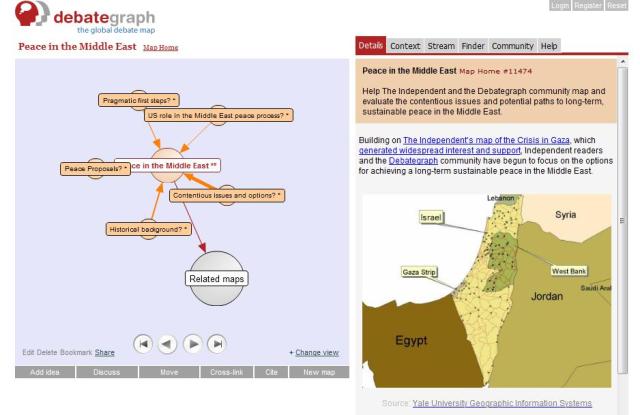
Another project on debate mapping and visualization is Debategraph, co-founded by Peter Baldwin and David Price. In Debategraph, contributions need to be broken down into a core set of issues (or questions raised), positions (or answers to the issues), and supportive or opposing arguments for and against these positions. The resulting structure can be visualized as a bubble map (much like a molecular structure) or a tree, which may contain cross-links to connect elements in different maps.

Argument mapping may certainly increase our capacity to identify the main issues at stake, find the best ideas, assess their pros & cons, and engage in creative thinking. In addition, the combination of visualization tools and new deliberation metrics should increase the potential of deliberation maps to structure collective knowledge as it emerges from communities.

But how large can large-scale argumentation be? The number of active users having contributed to deliberative maps in the two projects above remains quite limited so far. Most likely, communities of active domain experts discussing on complex issues won’t typically be very large, but what if thousands of engaged discussants contribute with tens of thousands of posts? How to curb down the costs of participation and the burden on moderators? Ontologies, already used in Debategraph, can be leveraged to decrease the costs of participation for authors, moderators, and readers. However, they might be hard to build and maintain. Which solutions could work best in this context? I’m probably pointing to another complex large-scale deliberation…

Marta Poblet

Posted in crowdsourcing, Uncategorized | Tagged , | Leave a comment

We the Crowd? Constitutional Reform 2.0

What do the spring in Iceland and in Southern Mediterranean latitudes have in common? Maybe in Iceland it comes slowly later in the solstice, as stated in Ron Bayes’ poem, but in both latitudes it has certainly keened the spirits by bringing a new light on politics and civic participation. Initiatives for constitutional reform have simultaneously blossomed in Iceland, Morocco, and Egypt, and Tunisia is catching up too. And the crowds have their say in them all.

In the aftermath of its financial meltdown, Iceland took the lead by passing a new Constitutional Act that provided for the random selection of 1,000 citizens to set the Icelandic National Forum 2010. The Forum facilitated the deliberation on constitutional values and issued recommendations for the new Constitution. Taking stock of these conclusions, the Constitutional Council—a publicly elected Assembly of 25 citizens—started to work on a constitutional draft and set an official website to publish updates, minutes, and live stream the deliberation sessions. The Council also subscribed to Facebook, Twitter, YouTube, and Flickr to channel civic participation. Icelanders submitted around 1,600 propositions and comments on the Council’s website and the Facebook page had more than 4,600 “likes” (the total population is 320,000 people).

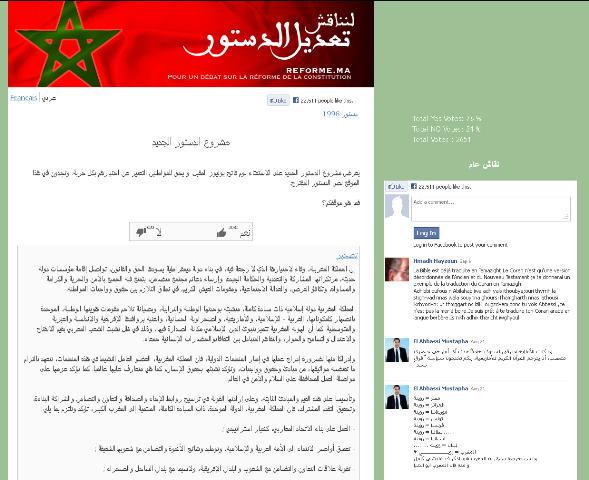
Morocco and Egypt immediately followed. Tarik Nesh-Nash, a software engineer from Tangier, and his colleague Mehdi Slaoui Andaloussi created Reforme.ma, a platform where people could vote the articles of the constitutional draft, make comments, and share them. In a few weeks, Tarik and Mehdi collected more than 10,000 comments, out of 200,000 visitors, and presented them to the National Commission of the Constitutional Revision that had solicited them. As I blog these lines Tarik and his colleagues in Morocco keep themselves busy by setting Marsad.ma, a platform to crowdsource the observation of the November 2011 election.

reforme.ma

In Egypt, the opposition leader Mohamed El-Baradei convened a consortium of NGOs to create Wathiqah, a crowdsourcing platform for the discussion of 17 fundamental human rights principles that would inspire the new Egyptian constitution. Wathiqah received expert and technical support from Cloud to Street, a Stanford based project that collaborates with Egyptian democratic activists. In the week of campaign, Wathiqah generated some 6,300 visits and 18,000 page views. Another constitutional venture is dostormisr.com, which follows the model of the Moroccan Reforme.ma to crowdsource public inputs on Egypt’s constitution.

The most recent initiative is Afktar Mostakella in Tunisia. Afkar has been recently founded by a group of Tunisian activists keen to support independent candidates for the election of the Constituent Assembly in October 2011. While not discussing any constitutional text, the website allows citizens to post ideas that independent candidates may support in the election campaign or feed the future constitutional debate.

Afkar Mostakella

Afkar Mostakella

To what extent the footprint of the crowds in this new generation of Constitutions will be traceable? Crowdsourcing platforms combined with social media have certainly provided unprecedented outlets for civic participation. Thousands of visits, votes, comments, and proposals contribute to raise political awareness and engage citizens to be part of those unique moments that shape the future of a country. And digital democracy may come as an essential component.

But the crowdsourced approach doesn’t come without a number of criticisms: unclear value proposition, relatively low levels of participation, lack of representativeness, over-simplification, or absence of metrics about the real impact on the final outcome (see Mary C. Joyce post here). Is Joyce right when she avers that “you don’t write a constitution online”? If you have no clear strategy, nor well-defined objectives or methods, or have failed to patiently weave an horizontal web of both offline and online constituencies, you probably won’t. But the examples above didn’t intend that either. Most of them have stepped to the fore fueled with the energy and enthusiasm of putting an end to decades of authoritarian rule. They learn by doing, and we all learn by their doing.

Marta Poblet

Posted in crowdsourcing, Uncategorized, Ushahidi | Tagged , , , , , | 1 Comment